Showing posts with label storytelling. Show all posts

Sunday, February 10, 2013

Open Elective - Rags to riches


Who does not enjoy a good story? Bedtimes, lunch breaks, vacations, occasions...contexts are unending, yet the feeling of wanting more is probably universal. Story times are occasions of taking a journey to the magical kingdoms or to ancient lands or maybe just a break from the reality. The best of our story tellers, our grandparents, could hold our attention for ages through narration as well as the content. Many elderly have interesting stories to tell - from the past, probably a lot regarding the present and some about the future.

During the Open elective course at NID this year (http://ioe13.blogspot.in/2013/) we explored the narratives which come so naturally to our elders. The umbrella theme for this unique 2-week module from 21st January-1st February 2013 was ‘Active Ageing’. The course was organised and conducted along with Sajith Gopinath, an industrial designer and faculty at NID, Gandhinagar (http://www.nid.edu/people/faculty/sajith-gopinath).  Sajith is interested in understanding the “concept of play/playfulness” as a tool for designers. He is also interested in designing play spaces as well as creating interactive space for children. We were also joined by a group of craftspeople from Ahmedabad. The aim was to capture and narrate these stories in a tangible contemporary visual story telling form using textile techniques and practices such as hand appliqué, hand embroidery and machine stitching. We wanted to combine the traditional craft with the contemporary aesthetics of the students who belonged to diverse design streams (textiles, film and video, exhibition, information and interface and product).  The final result was a small exhibition that included products as well as an installation. 
The stencils made by the students for doing the applique work forms a screen near the entry of the exhibition
We spent the first 3 days connecting with elderly people both familiar and unfamiliar and expressing these stories and experiences using visual mediums. The idea was to sensitise the students to the world of the elderly and understand the power of communication. 


On the left is the work of Sarah, exchange student at NID from Manchester School of Art and on the right is the work of Neha, a textile design student at NID. Both used different mediums to express their collected stories and share it with the group on the second day of the elective.
Panels prepared by Aarushi and Gowri, design student at NID to narrate the stories of technicians or kakkas as we fondly call them at NID. For them the character of the person was more important than the face and hence they have used shadows to express the stories
On one of the afternoons, students visited senior citizens in their homes and in old age homes and day care centres for a one to one interaction session. They came back filled with the warmth that one often associates with our grandparents.    
 
Sarah illustrating the profile of a resident.

Anamika with an elderly person at the Red Cross old age home in Ahmedabad.

Shruti’s depiction of her interactions with Dr. Armeti Davar in Ahmedabad
 
We gave creative freedom to the students and had interactive sessions with them where they were encouraged to narrate these stories and other insights using a medium of their choice. As part of the elective we also engaged experts like Dr. Anwar Ali, an occupational therapist, Mr. S.Sethuraman, an independent design practitioner and Mr. Massey from Helpage India. The end results of these interlaced interactions were low cost high value products like story books, boardgames, and craft products, all designed with a positive message for the greying population. The students worked along with the craftspeople learning the craft as well as translating it into a finished product. For the installation, the students worked on a 10” x 10” textile square and interpreted a story of their choice using hand appliqué and patchwork.  

The students working in the courtyard along with the craftspeople in NID
Sonika choosing the fabrics for the appliqué.
From Left to right: Anupreeta, Aashish & Shaheen's interpretation of their chosen stories using textiles
We added another layer of symbolism to the concept of storytelling through textiles. For their final product, the students were prodded to introspect, connect the dots and realise a product that had a deeper meaning – either something that the people whom they had interacted with could take away something from or something inspired from their lives and stories. It was challenging in the limited time to actually ‘think’ and create an out of the box product that had a message. 

From left to right: Anamika's reminder softboard, Vivek's Gamcha, Aashish's experience notebook & Aishwarya's Shadow lamp
 Each of the students also compiled all the work they had done during the workshop in a journal. 

A page from Lola’s Journal showing her ideas for the final product and an illustration of the craftspeople.

The final installation was well received by the visitors.


For me it was an extremely satisfying experience to hear all the stories and guide the students to transform them into textile pieces. All the students worked very hard and there was never a moment to complain. The craftspeople enjoyed themselves and left the workshop having learnt newer avenues to utilise their craft in. Excellent support was provided by the Open elective team and workshop staff at NID in realising the final installation. And with Sajith around everything seemed possible. ‘Rags to riches’ was an exhausting but I hope good learning for all the participants.

Thursday, April 26, 2012

Re-imagined Dreams

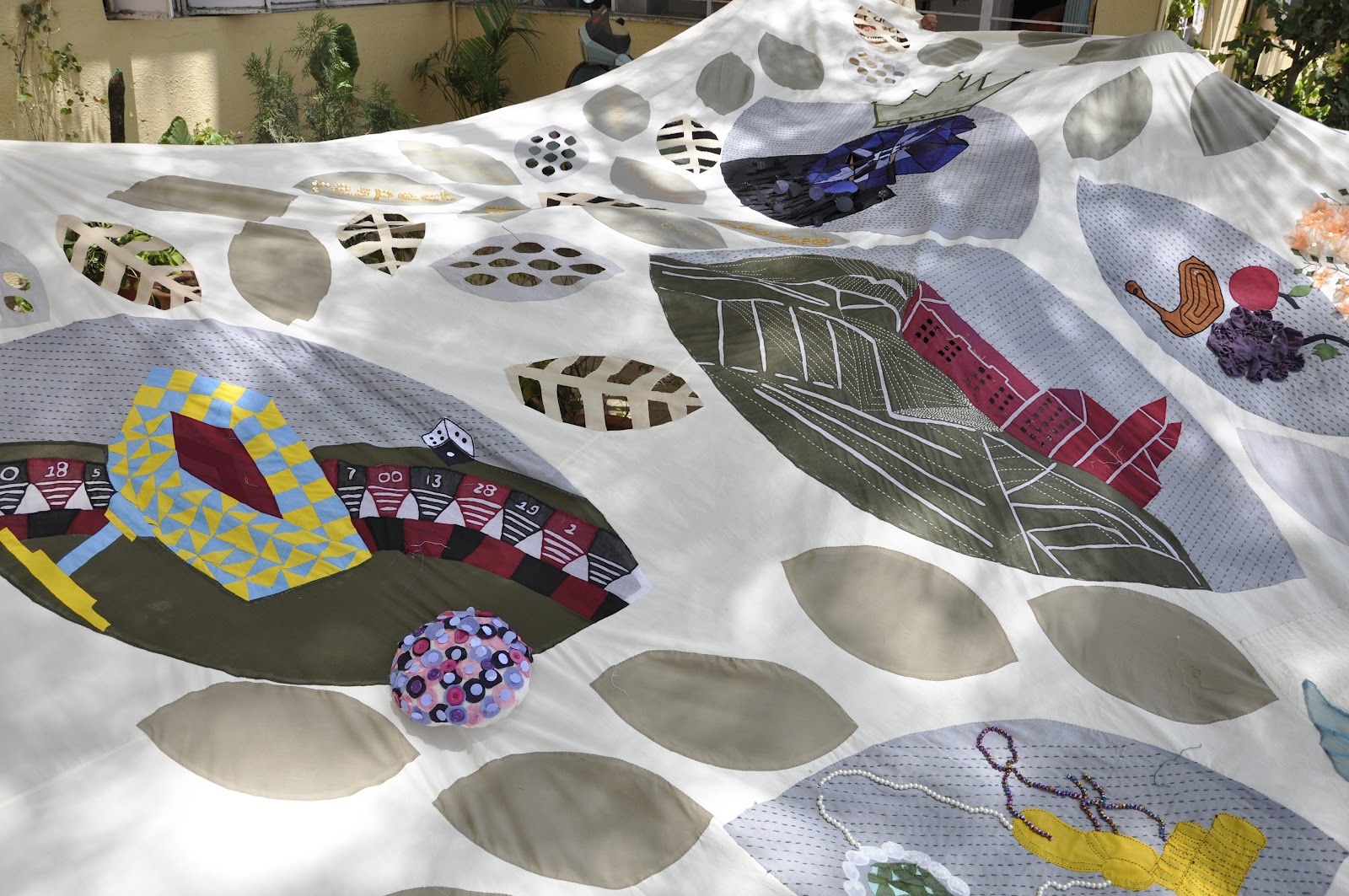
Last month, I worked on a narrative textile installation (4mts. x 6mts.) for the first time in my life. It was commissioned by Sabari Majumdar, a graduate of Goldsmith University and an alumni of National Institute of Design, India (http://www.gold.ac.uk/icce/alumniprofiles/sabarimajumdar/) for the Alchemy Festival 2012 at the Southbank Centre, London. The installation was a culmination of the numerous design workshop and storytelling sessions Sabari conducted with South Asian women in London reinterpreting a traditional South Asian folk tale entitled 'A Flowering Tree'.

"Synopsis of the Flowering Tree
Once upon a time, there were three sisters who lived in a forest. The eldest sister had the magical power of turning into a flowering tree. One day the king of the nearby village was passing through and he saw the girl. He wanted her to be his wife, and persuaded her to come with him. He took her back to his palace and wished her to turn into the tree. The girl was unhappy and couldn’t transform. Enraged he locked her away as punishment. Isolated and depressed, soon the girl fell ill. The king called for her younger sisters. The elder girl gave them a seed, which they planted back in the forest. Seasons passed and the tree blossomed. And one fine day, it transformed into the girl. The sisters were happy to be together again." Source: http://cargocollective.com/sabarimajumdar/Re-imagined-Dreams-I-Show
The Final installation at my studio in Ahmedabad

The Starting Point 

Sabari sent me images of the workshop conducted in London, along with vector drawings and jpeg images of the artwork. We had long skype sessions discussing textile techniques, materials, colours etc.

3-D flowers created by the participants in London. Photo Credit: http://cargocollective.com/sabarimajumdar/Re-imagined-Dreams-I-Show

Techniques used by the workshop participants to give form to their ideas. Photo Credit: http://cargocollective.com/sabarimajumdar/Re-imagined-Dreams-I-Show
The Final artwork for the Flowering Girl. Photo Credit: http://cargocollective.com/sabarimajumdar/Re-imagined-Dreams-I-Show

The Final Artwork with the Kings element. Photo Credit: http://cargocollective.com/sabarimajumdar/Re-imagined-Dreams-I-Show

Preparation for Production

These drawings were printed on actual scale (4 mt x 6 mt), and became the base for us to begin work. 
The artwork printed on translucent gateway sheets
Fabrics were sourced, craftspeople were identified and a work flow was set in pace so that we could achieve a good quantum of work everyday. Progress of each day was documented and emailed to Sabari for approvals.

It took us 15 days (and a couple of full nights) to have the package ready. My team comprised of a group of six local applique craftswomen and my tailor and without their support and hardwork it would not have been possible to meet the tight deadline. 


Actual Production

Applique artisans working on different parts of the piece. The kings leaves were the first pieces that we begun working on since they were very elaborate.

The small leaves were the last object we worked on, since they were scattered throughout the piece and required cutwork for the back lighting to cast shadows on the floor. 


The Final stitching of the edges of the installation


Punching Holes and fixing the metal rivets on all the four sides, so that the installation can be rigged up and stretched from all the four directions
Details of the central element of the installation - the girl. Each flower in the hair of the flowering girl was crafted in organdy by hand and attached towards the end of the project.

Details of the hand appliqued King's leaves. Layering played a very big role to add dimension to the piece. We had to keep in mind that the final installation was going to be back lit, so the finishing had to be immaculate.
The Final Installation in London

Panel showing the work of the participants of the workshops in London. Photo Credit: http://cargocollective.com/sabarimajumdar/Re-imagined-Dreams-I-Show

Visitors enjoying the exhibit. Photo Credit: http://cargocollective.com/sabarimajumdar/Re-imagined-Dreams-I-Show

The shadows of the cutouts on the floor. Photo Credit: http://cargocollective.com/sabarimajumdar/Re-imagined-Dreams-I-Show
The backlit installation showing details of the Flowering Girl

The audience interacting with the installation at Southbank Centre, London
My experience 
The sheer scale of the installation was scary to begin with, especially the given time and budget constraints. But once I started planning and putting together the team and work flow, my inhibitions were overshadowed by the zeal to create a piece that I would be proud to associate myself with.


It was a delight to work with Sabari, as her attention to detail fuelled us to deliver our best. The numerous phone calls and skype meetings managed to bridge distance as we worked across two continents in transforming Sabari’s vision to a tangible product. In retrospect, what I particularly liked about this project was sitting with my team of craftspeople planning, cutting, stitching and doing embroidery hands-on.


Majority of the artisans were young girls staying in a close knit conservative society. For them to leave their homes and come and work on this project and on some days during the nights too, was an achievement. Geeta ben, the master craftsperson, says, “I pray to God that this project is approved and people see our work and come back for more. But Shweta make sure you have more time to work in the future.”

This project has been a successful first attempt for me. I hope the exhibition managed to communicate to the viewer, the hard work and creative energy that has gone in realising 'Re-imagined Dreams'. 

Exhibited at Alchemy Festival from 12th-22nd April 2012 at Southbank Centre, London. Photographs of London by Sabari Majumdar. Photographs of India by Sanjay Guria.

Friday, December 16, 2011

Each special...continued...

I was chatting with the gardener at NID a couple of days before and he was telling me about some of the characteristics of the popat or the parrot and its love for the fruit trees. For the past few days, I have been thinking of writing a new poem on birds and fishes, and this conversation gave me a good starting point. Delving into the rich folk history of India, I discovered various interpretations of a popular story of a parrot and the Fig tree. In the Mahasuka Jataka, the story of the parrot is related to the life of a monk who is tempted to leave his home for want of alms, since the village is unable to provide for him. My next poem, a continuation of the earlier poem 'Each special' is inspired from this folktale, with my own twist added to it. I will let everyone enjoy the poem, while I move on to develop the illustrations and products based on it.


“To me, he gave wisdom”
The playful parrot spoke up
I can repeat whatever you say
I love to chatter, eat nuts and fruits
I can chew for the entire day!
“Each one is special, I agree wise owl”,
Look at my friend the Fig tree.
He gives me shade, food and a home
Together we will always be.
“But what about autumn, when the tree has no fruits,
And no leaves to protect from the sun,
Seasons change, Popat tell me?
Will you leave your friend and run?
Never, said Popat, come what may,
Our friendship is loyal and strong
Our hearts are linked like the fish in the sea
I will die but not break the bond.